Nicetown-Tioga residents celebrate greening initiatives
October 10, 2025
Discover Nature Journaling at Hershey Gardens
November 20, 2025
A CHANGING CANOPY
Jenkins Arboretum & Gardens
JENKINS. Summer + Fall 2025
What truly sets Jenkins apart—and establishes a strong sense of place—is its magnificent canopy.
From stately tulip trees to graceful arching oaks, Jenkins’ mature canopy creates a grand backdrop
for everything that happens in the gardens. But this canopy is more than just a beautiful setting—it’s
the latest chapter in a rich, multi-generational story of both loss and resilience.
HISTORY
The first half of the 20th century brought significant changes to the land that would eventually become Jenkins. Once home to a mature canopy dominated by American chestnut trees (Castanea dentata), the landscape was devastated by the chestnut blight, which wiped out this keystone species across hardwood forests throughout the East Coast, arriving in Chester County in 1912. As the chestnuts disappeared, young oak trees began to fill the void, marking the beginning of a new phase in the forest’s natural succession.
Amid these changes, the Jenkins family purchased land and moved onto the property in the 1920s. H. Lawrence and Elisabeth Phillipe Jenkins fell in love with the evolving landscape, inspiring them to preserve the land as a “public park, arboretum, and wildlife sanctuary” after their passing. Because of the Jenkins’ foresight—along with the foresight of their neighbor Louisa Browning, who would add her property to the total acreage of the Arboretum— the landscape was protected against the pressures of suburbanization and development that would increase with each decade.
By the 1970s, the transformation into a public arboretum was proceeding under the direction of landscape architect George E. Patton, who described in his plans a thriving canopy of red and chestnut oaks (Quercus rubra and Quercus montana), red maples (Acer rubrum), and tulip trees (Liriodendron tulipifera). These trees, along with many others, continue to shape the landscape today.
MANAGEMENT
Although protected from suburban development, ongoing challenges of disease and environmental changes continue to threaten the health of our canopy. In recent years, a combination of diseases has plagued our mature oaks, including bacterial leaf scorch and hypoxylon canker. In addition to pest and disease pressure, our canopy is experiencing increasing stress from intensifying weather patterns, as seen in the devastating drought of 2024 and the severe derecho storm of 2020 that destroyed 80 trees.
At first glance, it appears that the struggles of our red oak canopy are destined to mirror the abrupt successional shift that occurred with the loss of the American chestnut. However, this time the landscape has help from Jenkins’ horticulture team, along with support from a team of arborists. Together, they are working to understand the challenges facing our canopy while planning for a more gradual change to the landscape’s next succession.
One of the best tools we have in protecting our canopy is knowledge! The more we know about our trees and the challenges they face, the better equipped we are to respond in the future. Every tree at Jenkins receives a unique identifying code based on the year it was added to the collection, known as an accession number. This code is then plotted on a map and entered into a database, which includes fields for regular health checks and ongoing maintenance. These records enable our horticulture team to monitor the health of individual trees and our extended canopy, informing decisions about how to evolve our landscape in the face of current and future pests, diseases, and climate challenges.
FUTURE
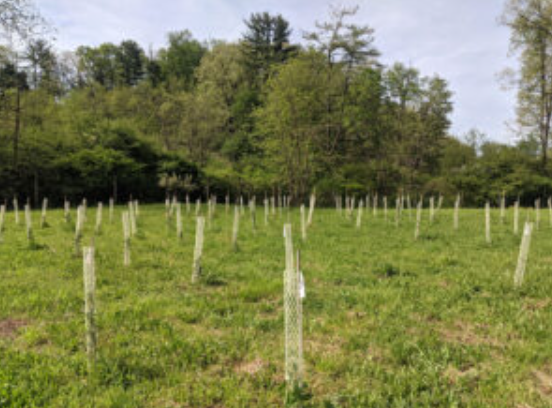
Our horticulture team, in collaboration with our Horticulture Committee and our partners at Shreiner Tree Care, is carefully planning for the future of our canopy. History has shown that landscapes dominated by a single tree species are vulnerable to devastating diseases, with monocultures that follow facing similar risks. To break this cycle, we are committed to replacing aging or diseased trees with a diverse mix of resilient species tolerant of harsher conditions.
Every tree we plant at Jenkins is chosen with a dual purpose in mind: to enhance habitat health and provide ornamental beauty for our visitors. We prioritize trees that support wildlife and pollinators while also contributing to the aesthetic appeal of the garden. Rather than replanting with a single dominant species, we are introducing a variety of trees to the gardens, including boxelders (Acer negundo), resilient trees with vibrant fall color; hickories (Carya spp.), which host moth larvae; and lindens and maples, known for their valuable pollen and nectar. Other species, like black birch (Betula lenta), chalk maple (Acer leucoderm), and Carolina basswood (Tilia americana var. caroliniana), are also being planted to ensure a diverse and sustainable canopy for years to come.
As we look to the future, the story of Jenkins’ canopy continues to unfold. Through careful management and strategic planting, we aim to foster a more resilient and diverse landscape that will thrive for generations to come. As you explore the gardens, take a moment to reflect on the journey of the trees around you. You may even spot some American chestnut trees that sprout and grow from old root systems, witnesses to our ever-evolving canopy.
See the full issue of JENKINS, Summer + Fall 2025: here